The REF™ Methodology
The Roleplay Evaluation
Framework.
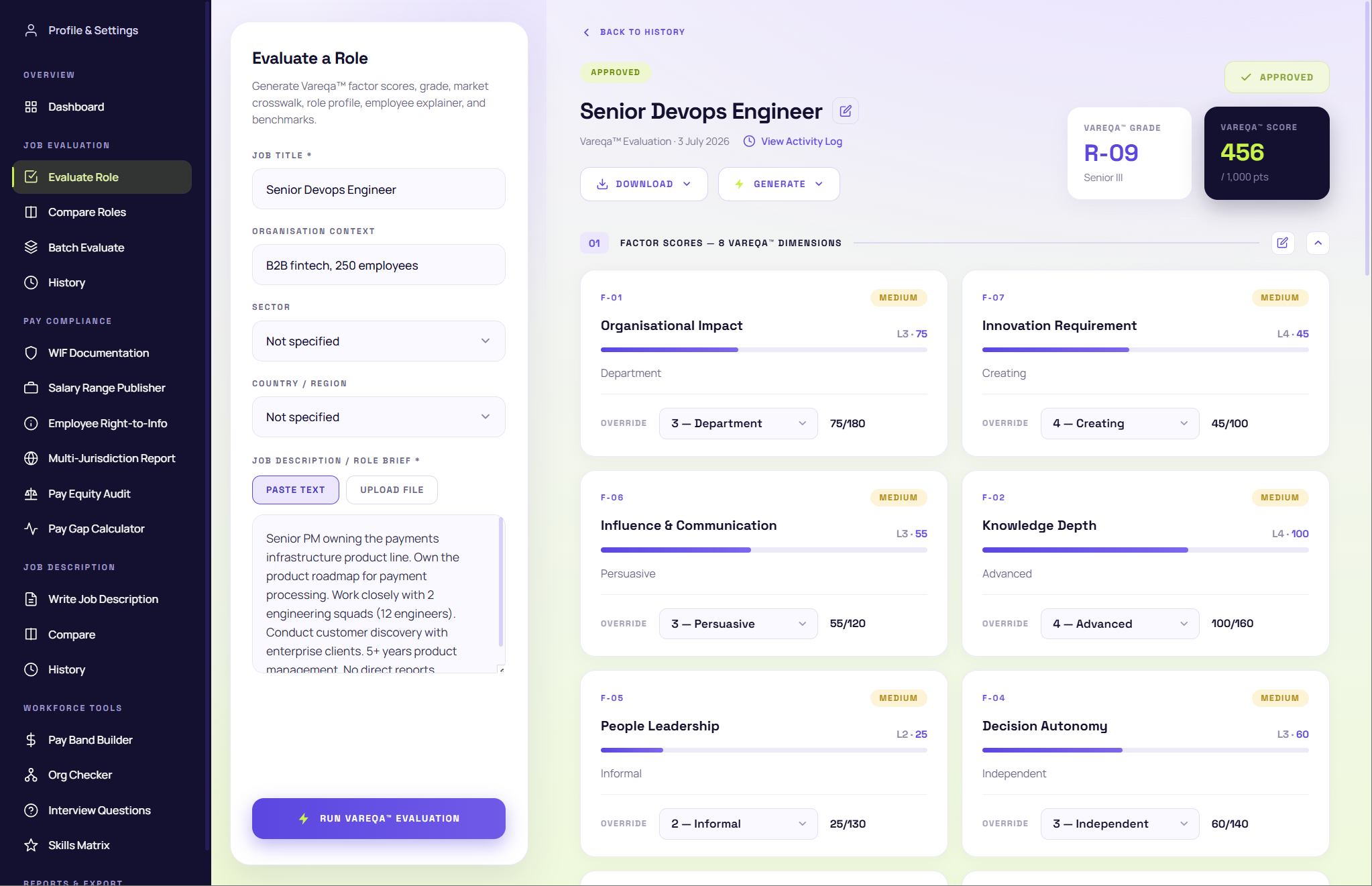
REF™ is the published, eight-factor, 1,000-point job evaluation methodology behind Vareqa. It produces 20 defensible grade outputs, R-01 through R-20, designed from first principles for Directive-native transparency. Every factor definition, level descriptor, and scoring threshold is documented and disclosable to employees, works councils, and regulators, without intermediary interpretation.
8
Compensable factors
20
Grade outputs
1,000
Maximum points
100%
Factors gender-neutral by design
Section 01
The REF™ Methodology
Eight compensable factors. Six levels each. One thousand maximum points. Twenty grade outputs.
REF™ Methodology · Proprietary & Confidential · Vareqa Ltd. The Roleplay Evaluation Framework (REF™) is an original eight-factor point-factor methodology developed and owned by Vareqa Ltd. The general concept of point-factor job evaluation is in the public domain. REF™ factor definitions, level descriptors, weightings, scoring tables, grade thresholds, and market equivalency calibrations are proprietary to Vareqa Ltd. and subject to copyright and trade secret protection. Any references to proprietary frameworks in the market equivalency guide below are for client migration and benchmarking convenience only, and do not constitute or imply any licence, endorsement, or partnership with the owners of those frameworks.
Grade Scale
REF™ Grade Structure · 20 Levels
Weighting rationale: Organisational Impact (18%) and Knowledge Depth (16%) carry the highest weights. Research consistently shows these two dimensions account for the most variance in job worth across industries. Decision Autonomy (14%) is scored as its own factor, not folded into accountability. Autonomy is what separates individual contributors from senior leaders, and it deserves its own weight. Innovation Requirement (10%) is scored independently to give proper recognition to technology, product, and R&D roles that legacy frameworks tend to fold into problem solving. Working Environment (2%) is retained at minimum weight to ensure the framework covers all role types and remains defensible under the EU Pay Transparency Directive and equivalent equal pay legislation.
Transparent by design
Factor definitions, level descriptors, point values, and weighting rationale are fully published. The methodology is architected for EU Pay Transparency Directive Articles 4 and 6 disclosure: employees, works councils, and regulators can access the full framework without intermediary interpretation. This is what the Directive actually requires, delivered natively rather than bolted on.
Gender-neutral by design
All eight factors have documented gender-neutrality rationale, defensible in a joint pay assessment under Article 10 or an employment tribunal. Weighting logic is testable and auditable from the platform itself. Third-party EDGE certification is under active consideration to provide an independently verifiable Article 4 compliance signal.
Section 02
Try the REF™ Evaluator
Select a level for each factor. Score updates in real time with indicative market equivalency.
REF™ Total Score VAREQA
0
/ 1,000 pts
REF™ Grade
—
Select factors to score
Live Market Equivalency Guide
KF / Hay — —
WTW GGS — —
Aon — —
Mercer — —
Equivalency values are indicative migration estimates only. Exact alignment requires re-evaluation under REF™ against your organisation's specific role set.
From role list to regulator-ready
Three steps. Under two weeks.
A 500-employee organisation reaches full EU Pay Transparency Directive compliance in under two weeks using the Vareqa Workbench. The same outcome via a traditional consulting engagement takes 8 to 12 weeks and costs roughly 10x more.
DAY 1
Step 01 · Upload
Role inventory in,
evaluation queue out
HR uploads the role inventory (CSV, spreadsheet, or typed directly). Typically 80 to 250 unique roles for a 500-employee organisation. The Workbench ingests role data, auto-detects role families, and queues each role for AI-assisted evaluation against the REF™ 8-factor methodology.
Output: evaluation queue ready.
DAYS 2-6
Step 02 · Evaluate
AI proposes,
HR validates
HR validates
For each role, the Claude-powered evaluator produces an 8-factor score with documented rationale at every level. HR reviews, overrides where domain knowledge dictates, and approves. AI scores and human overrides are both retained as audit trail for Article 6 transparency. Around 2 minutes per role; a 200-role organisation completes the pass in 3 to 4 working days.
Output: defensible grades R-01 to R-20.
DAYS 7-10
Step 03 · Publish
One click to
regulator-ready
regulator-ready
The grade anchors every downstream output. The Pay Band Builder constructs salary ranges. The RTIR module generates Article 7 reports in the employee's language within minutes. OLS regression runs the adjusted pay gap with Article 9 trigger assessment. The Multi-Jurisdiction Compliance Report maps the organisation across 15 jurisdictions.
Output: compliance pack published.
Why this matters commercially. The traditional alternative for a 500-employee organisation is an 8 to 12 week consulting engagement costing €80,000 to €200,000, delivered by licensed consultants. Vareqa produces a defensible outcome in under two weeks at €15,000 annual SaaS (Professional tier), with methodology architected for Article 6 transparency and direct disclosure to employees, works councils, and regulators. That is a 5 to 10x cost compression combined with a Directive-native transparency posture that the consultant-mediated delivery model is not structurally configured for at the mid-market price point.
Section 03
Market Equivalency Guide
Indicative migration ranges for organisations transitioning to REF™ from an existing point-factor framework.
REF™ Roleplay Evaluation Framework
KF/Hay Korn Ferry Hay Guide Chart Method
WTW GGS Willis Towers Watson Global Grading System
Aon Aon JobLink™
Mercer IPE Mercer International Position Evaluation
| REF™ Grade | Points | Level Title | KF / Hay | WTW GGS | Aon JobLink | Mercer IPE | Career Stage |
|---|
Basis and limitations. This table is an indicative migration guide only, intended to help organisations estimate where their existing role architecture might map onto REF™ grades. It is not a claim of formal equivalence to any proprietary framework. The equivalency references are Vareqa-originated alignments drawn exclusively from publicly available methodology documentation (vendor marketing materials, public academic and policy literature, and third-party cross-reference sources); no licensed manuals, subscriber-only materials, or confidential client deliverables were used in their construction. Ranges are approximate and confidence is highest for mid-career grades (R-07 through R-14). Actual role placement within any proprietary framework depends on organisation size, industry context, and role-specific factors that only that framework’s own evaluation process can determine. The named frameworks are trademarks of their respective owners; references are for identification and migration convenience only and do not imply endorsement or partnership. Any organisation relying on these ranges for pay band construction or compliance reporting should re-evaluate the role directly within REF™ using the full 8-factor scoring process to produce a defensible grade output.
Section 04
Factor Correspondence Map
How each REF™ factor relates to conceptually adjacent factors in commonly used proprietary frameworks.
KF / Hay
3 factors · ~1,000 pts · Guide Chart method
- →Know-How
- →Problem Solving
- →Accountability
WTW GGS
7 factors · up to 25 global grades
- →Job Functional Knowledge
- →Business Expertise
- →Leadership
- →Problem Solving
- →Nature of Impact
- →Area of Impact
- →Interpersonal Skills
Aon JobLink™
5 factors · 14 grade levels
- →Knowledge
- →Problem-Solving
- →Accountability
- →Interaction
- →Working Conditions
Mercer IPE
4+1 factors · 10 dimensions · 48 classes
- →Impact
- →Communication
- →Innovation
- →Knowledge
- →Risk (optional)
Section 05
Why REF™ is defensible
Five ways the methodology is architected to hold up under regulator scrutiny, tribunal challenge, and works council review.
01 · Directive-native architecture
Built against Articles 4, 5, 6, 7, 9, and 10
Every REF™ output is mapped to a specific obligation in the EU Pay Transparency Directive 2023/970. The factor framework satisfies Article 4 (gender-neutral criteria). The published methodology satisfies Article 6 (employee-accessible pay determination logic). The Workbench generates Article 5 pay range disclosures, Article 7 right-to-information responses within 60 days, Article 9 pay gap reporting, and Article 10 joint pay assessment support where the adjusted gap exceeds 5%.
02 · Gender-neutral by design
Documented rationale for every factor
All eight factors carry written gender-neutrality rationale, defensible in a joint pay assessment under Article 10 or an equal pay tribunal. The factor set deliberately balances dimensions that historically advantage different populations: technical depth (F-02, F-03, F-07) weights depth of mastery independently of people leadership (F-05), ensuring individual contributors are not structurally penalised against managers.
03 · External legal opinion
Commissioned validation planned
A commissioned opinion from recognised EU employment counsel on REF™'s Article 4 and 6 defensibility is planned for inclusion in the GC briefing pack provided to procurement teams. The opinion addresses whether the methodology satisfies the Directive's gender-neutral and employee-accessibility requirements, and whether it is defensible in a pay equity proceeding.
04 · Third-party certification
EDGE Certified Foundation, under active consideration
Independent gender-neutrality certification through the EDGE Certified Foundation is under active consideration. This would produce an independently verifiable Article 4 compliance signal, reinforcing REF™'s transparency positioning in enterprise procurement and providing an external credential that consultant-mediated proprietary frameworks typically cannot match.
05 · AI-assisted, not AI-determined
The methodology is the anchor. The AI is the accelerator.
Defensibility is anchored in REF™ itself, not in the AI that accelerates its application. The Workbench uses Anthropic Claude to propose an 8-factor evaluation; HR reviews, overrides where domain knowledge dictates, and approves. Both the AI-proposed score and any human override are retained as audit trail under Article 6 transparency requirements. If a tribunal, regulator, or works council asks why a role sits at its grade, the answer is the documented factor scores, not the opacity of a black-box model. This is the crucial distinction from AI-only pay analytics tools that cannot produce a regulator-facing methodology on demand.